QuickBooks doesn’t actually scan invoices — here’s the gap
QuickBooks includes a built-in Receipt Capture feature for photographing single-page receipts and matching them to expenses, but it has no native capability for scanning multi-line vendor invoices. That distinction matters: invoices have complex, inconsistent tabular layouts — different column orders, merged cells, multi-line descriptions — that a receipt-focused tool isn’t built to parse. A misread quantity or unit price in a line-item table cascades into an incorrect bill amount once it’s synced.
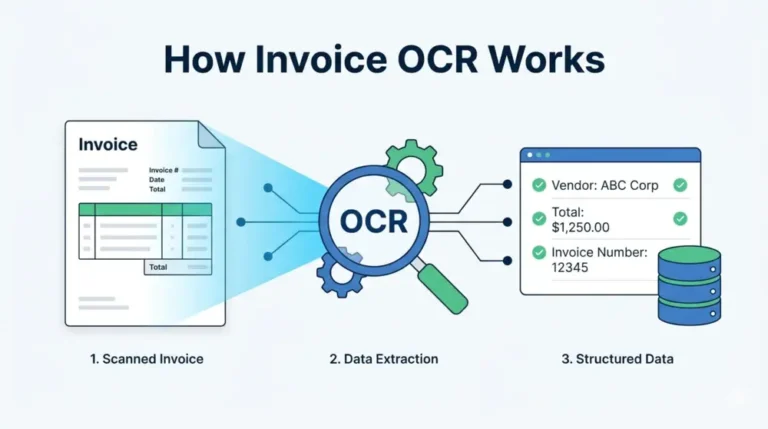
This is why most QuickBooks users doing any real invoice volume add a third-party invoice OCR tool that captures the document, extracts structured line-item data, and syncs the result into QuickBooks as a bill ready for review.
How the integration actually works
There are three common connection methods, in order of how much setup they take:
- Direct integration — the OCR tool has a built-in QuickBooks connector; you authorize it once and extracted invoices sync automatically as draft bills.
- Zapier or Make — for API-first tools without a native QuickBooks app, you connect them via an automation platform; this takes more setup but works with a wider range of tools.
- Custom API — for developers who want full control over the sync logic (e.g., matching invoices to purchase orders before they hit QuickBooks).
Most SMB users are best served by direct integration where available — it’s the least to maintain and breaks less often than a multi-step Zap.
Tools that connect to QuickBooks
| Tool | Connection to QuickBooks | Free tier | Best for |
| Nanonets | Direct integration | 500 pages/month | No-code teams wanting self-serve setup |
| Dext Prepare | Direct integration | 14-day trial only | Accountants managing multiple QuickBooks clients |
| Veryfi | Via Zapier or custom API | 100 documents/month | Developers, mobile-first capture |
| Mindee | Via Zapier or custom API | 250 API calls/month | Developers building a custom pipeline |
| Rossum | Direct integration (enterprise) | Trial only | Mid-size AP teams on QuickBooks Online Advanced |
Nanonets and Dext Prepare both offer a direct QuickBooks connection out of the box. Veryfi and Mindee are API-first tools typically connected via Zapier or custom code, which suits teams with a developer but adds setup overhead for everyone else. Rossum targets larger AP teams and connects at the QuickBooks Online Advanced tier.
What to check before you choose
- Line-item accuracy specifically, not just header-field accuracy — vendor totals matching is less useful if line items still need manual correction.
- Batch processing — if you’re processing 50+ invoices a month, uploading one at a time isn’t viable; confirm the tool supports bulk upload or an email-forwarding inbox.
- Whether bills land as drafts or auto-post — most accountants prefer a review step before anything posts directly to the ledger.
- Multi-currency and non-English invoice handling, if relevant — several tools in this category have documented weak spots here.
- Per-client vs. per-document pricing, if you’re a bookkeeper managing multiple QuickBooks files rather than one business’s AP.
Frequently asked questions
Does QuickBooks have built-in invoice OCR?
No — QuickBooks’ native Receipt Capture handles single-page receipts, not multi-line vendor invoices. A third-party tool is needed for structured invoice data extraction.
Which invoice OCR tool integrates directly with QuickBooks without Zapier?
Nanonets and Dext Prepare both offer native QuickBooks connections. Veryfi and Mindee typically require Zapier or a custom API integration.
Is there a free way to get invoice OCR into QuickBooks?
Nanonets’ free tier (500 pages/month) is the most complete free option with a direct QuickBooks connection.
Do extracted bills post automatically, or do I review them first?
This varies by tool and by your configuration — most platforms default to creating draft bills for review rather than posting directly, but confirm this setting before connecting a live QuickBooks company file.
Methodology & disclosure
This guide draws on published vendor integration documentation and independent third-party comparison coverage, cross-checked across sources rather than taken at face value from any one. We have not independently tested each QuickBooks integration ourselves; connection methods should be verified on the vendor’s current site before you commit, since integrations do change. InvoiceOCRHub may earn a commission from some links on this page.
Related guides
- Best Invoice OCR Software in 2026: Full Comparison & Buying Guide
- Nanonets vs Dext Prepare: Which Is Better for Invoice Processing in 2026?
- Veryfi vs Nanonets: Which Invoice OCR Tool Is Right for You in 2026?